

The Great Grain Robbery: A great rainy-day read; The Great Grain Robbery of 50 years ago changed global food pricing forever
Ontario Farmer
Byline: John Parsons
Source: Ontario Farmer
The writer is a retired CPA/CGA in Sturgeon Falls jparsons@fibreop.ca
A few short days from now, Sunday July 3, 2022 to be specific, will mark the 50th anniversary of the start of an extraordinary commodities trading event. This pivotal scene of subterfuge and misdirection over the rest of that month, coupled with perfectly legal transactions, was later dubbed the 'Great Grain Robbery'.
Most readers, other than a few old codgers like myself, might not know about these events from half a century ago, but they changed the face of global food pricing forever. One could say it marked the turnaround in farm fortunes as land values increased, equipment was enlarged and modernized, and a business mentality took hold.
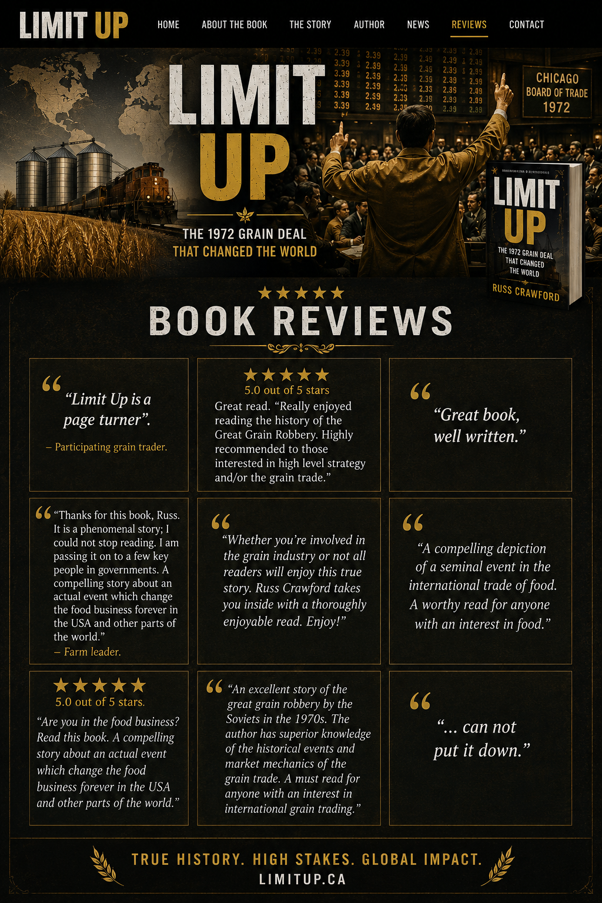
Russ Crawford, a 50-year veteran of commodity trading - 20 of those years with the massive agribusiness firm, Cargill, has brought the underlying story to life in a compelling new book, 'Limit Up'. The incidents portrayed in his book are based on actual events which occurred in the summer of 1972.
As Crawford pointed out in an email to me "most of the characters are real people but some have been created or modified to fill gaps and make the read a bit more interesting. That's the only reason the story has a historical fiction genre attached to it."
He has done such a masterful job of weaving those aspects into the story that you'd be hard-pressed to separate fact from fiction. It has made the book thoroughly entertaining as well as a series of lessons on how grain trading really works.
You and I are only small cogs in the wheel, managing our cropping enterprise risks through a combination of storage, selling into the market, or utilizing forward contracts to give us some price stability. Multiply those risks exponentially when dealing in hundreds of thousands, even millions, of tonnes of corn, wheat, soybeans, or canola, and you enter the world of the commodity trader.
One can echo the words of Jim McCrea, a key player in the unfolding drama. He is a real-life person who grew up on a mid-western US farm and, after graduation from Iowa State University, became a star at Cargill. After the excitement of the 1972 harvest, McCrea responded to a comment from his boss that he should never lose touch with his farming roots: "I won't. My dad won't let me. He thinks I'm some sort of marketing genius now and wants me to help him market his grain. Boy, is that ever a change from a few years ago."
We can easily recall the extreme drought conditions of just a year ago in our prairie provinces. Wheat, canola and barley production plummeted with year over year declines of as much as 48.1% in Saskatchewan wheat alone. Livestock producers were forced to cull their herds. But then a fundamental economic rule of supply and demand entered the picture. Crop prices rocketed upwards, a bonanza for farmers elsewhere in the country who enjoyed decent harvests.
Flip back to 1972, and a similar situation played out across Europe and particularly in the highly fertile black earth belt stretching from Ukraine through the Russian Volga Plains to as far east as Kazakhstan. Throw in the likelihood of mass starvation for the Russian population and you have the potential for unprecedented disaster.
How they got out of that mess is the story in this book through the eyes of Misha Fisenko, a fictional person but artfully based on a real-life Russian bureaucrat who participated in the solution.
The title of 'Limit Up' is a stroke of genius. For those not familiar with the term, it is a safety mechanism used by regulators to prevent volatility from reaching extreme levels in commodities markets. Limit up is the maximum amount a price is permitted to increase during one trading day. Conversely, limit down is the maximum permitted decline in one day.
Almost a year after the events portrayed in this book, a Chicago Board of Trade news release for the period of July 15 to Aug. 22, 1973, noted that "the market price for wheat nearly doubled to $5.43 per bushel. It traded limit up an unprecedented seventeen of 21 trading days in July."
Delving back into the story's 1973 fireworks; picture an August meeting in Cargill's nerve centre, the Lake Office in a quiet, rural suburb of Minneapolis.
In the boardroom, McCrea regales the trading team with: "All hell has broken loose since [last year]. We have no idea where the top is, and there hasn't even been much trade for the past two weeks." "The bell rings on the floor, traders scream their heads off for two minutes until they peg the market at limit up and that's it for the day. It's unbelievable."
Author Russ Crawford isn't making this up out of whole cloth. He may have resorted to a little poetic license with that verbal banter, but the background is factual. We also get a front-row seat into the minds of those grain managers from the Communist Bloc.
As Fisenko explains to his boss at Russia's Exportkhleb: "Commodity markets move on their own accord and no one has control over them - not the large private grain companies and not the American government." "Here in Russia we would just set the price and that would be the end of it. But in the capitalist world, markets work differently."
The book is not limited to the esoteric world of commodity trading. For sure, we're treated to negotiating sessions, horse-trading, and the pressure of careers on the line if a wrong decision is taken. But at a more fundamental level, we get some insight into Soviet farming methods versus those in North America. All of it is wonderfully presented in engaging dialogue with a high level of tension lurking in the background.
Perhaps most significant for me was a telling exchange between Fisenko and McCrea as they rolled across the North Dakota prairie to check out 1972's hard spring wheat crops. They were discussing farm sizes. The bigger farms in the state did not surprise the Russian at all; they had many huge collective farms back home. But the diversity in sizes bothered him.
Turning to McCrea, he let his feelings out: "This seems so unfair to me, Jim. Are smaller farmers jealous and angered by the larger farmers? Do they feel cheated?" McCrea thought that over for a minute, then explained: "I wouldn't describe it that way. Everyone works and lives within their means, striving to maintain their business or expand it if getting bigger is their ambition."
"But farming in America is more than just a business. It's a lifestyle. Farmers are the most independent people in the country. They are their own bosses."
There's tons more of that as we move through politburo meetings in the Kremlin to the boardrooms of private grain trading companies in North America; from the luxury lifestyle of Geneva to the backroads of America.
It's a riveting tale of suspense and intrigue where we get a front-row seat into political machinations, sophisticated trading strategies, and a glimpse of how it all relates to us on the farm. The entire journey through this book is thought-provoking while at the same time being a delight to read.
You can find this on Amazon.ca in paperback, or a Kindle version. Before that, though ... head to www.limitup.ca. Don't worry. Sifting through this background material will not give away the plot and spoil the story.
Among other things you'll find a detailed explanation of how the Chicago Board of Trade works, as well as a synopsis of several venues crucial to the story as it unfolds. Make a point of clicking on 'the author' button. I don't think anyone other than Russ Crawford with his commodity trading background could have written this.
Then hit the 'Buy the Book' button, which will take you right to amazon.ca. You won't be disappointed.